This post is the first part of the final post in my series about my FCX Journey. It picks up from when I passed the FCX written exam and goes through my prep for the lab, plus my experience for first attempt. The aim is to provide as much advice as I can for prospective FCX candidates within the bounds of the NDA.
Other posts in this series can be found here:
Post 1 – About the FCX
Post 2 – FCX Study Tracker
Post 3 – Journey to the Written
Post 4b- Lab Exam Part 2
As mentioned in my last post, I passed the FCX written exam on February 10th 2023. I had chosen to sit the 811 version of the exam to take advantage of the study I had been doing in the 18 months prior on the lower level Fortinet certifications, but with that version of the exam about to be retired I didn’t give myself a whole lot of prep time or room for error. I’d thrown everything I had into that exam studying 20-30 hours a week on top of work for 6 weeks and by the end was exhausted, so I decided to take a short break before launching into study for the FCX.
Throughout this post and its second part, I will refer to Fortinet certifications by their old naming as well as their new naming. This is because Fortinet changed the certification scheme in the middle of me studying for and getting the FCX. So for reference:
Old Scheme – Network Security Expert levels 1 – 8. The NSE8 = the FCX
New Scheme – FCA (NSE1-3), FCP (NSE4-6), FCSS (NSE7) and FCX (NSE8)
Please note these are a simplification, but give you the general gist.
Time frames
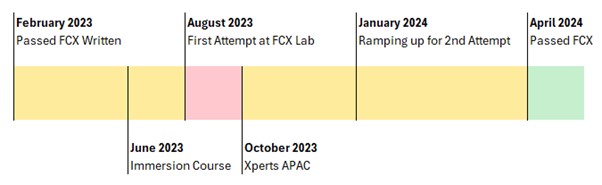
For my first attempt, I set a target of the last week of August to sit the exam. I had two reasons for this:
- I wanted to get the certification before they changed the name (so that I had a NSE8 as well as the FCX after the name change). In the end this was arbitrary, but it would have satisfied my internal desire to have all the Fortinet NSE certs – 1 through 8.
- Maintaining 20-30 hours of study this gave me between 450 and 690 hours of dedicated study time – Id worked out that to get through the course materials it would take me at least 500 hours of study to be what I figured was proficient enough.
With this in mind, I organised to attend the FCX Immersion course in June as a trial run to give me an indication on where I was up to in regards to my preparation. For those who do not know, the Immersion is a preparation course for the FCX exam that runs for two days. In the course you get access to a lab environment that mimics the actual lab except it uses different questions. You get to see what the jump hosts are like and what tools you have access to, how you will be given the questions, and how you will be expected to complete tasks.
In order to get the most benefit from this course my recommendation is to prepare for it like you are preparing for the actual lab, and then go into the course “blind” (without getting information about it beforehand). It puts you under similar pressure as the lab, but you have access to an instructor if you get stuck that you can ask questions of.
The other advantages are that the course gives you a score to show how you are doing and gives you the answer to each task after you have done it (or when you ask for it). This experience is invaluable, and I recommend that every candidate do it ahead of the exams – the caveat is that the course costs $1900 USD.
More information on the FCX Immersion course can be found on the Fortinet training institute site:
https://training.fortinet.com/local/staticpage/view.php?page=library_fcx-immersion
After sitting the Immersion course in June, I felt confident in the lead up to the exam. I took a total of 4 weeks off work between the beginning of June and the end of August when my exam was to give me extra preparation time and focused on getting to know how to complete the tasks within the immersion course, and on getting quick with certain tasks. I spent as much time labbing as I could, but by this point I hadn’t gotten through all of the course materials due to work pressures. I was sure this wouldn’t matter.
First Lab Attempt
As you would have seen from my first graphic, I had to sit the exam twice in order to get my FCX. The day before the exam I had gone into work and gotten the meeting room I would be using ready:
- I removed any writing on the whiteboards.
- I set up my work area, with two monitors, a keyboard I’m used to and my mouse.
- I covered up the conference room TV
- I made sure I had an external web camera to be able to show the room when the proctor asked.
- I made sure I was connected to the office network via Ethernet rather than Wi-Fi (reduce the variables as much as possible).
The night before I knew it was too late to do any study, and I attempted to get a good night’s sleep. Unfortunately, I couldn’t sleep all that well, so at 4:30 in the morning I decided it was best to go into the office and do some study to freshen up ahead of the exam.
I got into the office and studied from the same room and as time went on I got gradually got more and more nervous. The lack of sleep definitely didn’t help my mood, and I had drunk some caffeinated drinks to “wake myself up” which only served to make me twitchy. But the time came, and I checked in with the proctor to begin the exam.
Prior to beginning the exam, the proctor asks to see your physical ID, where your phone is stored, and to show them around the room using the webcam including under the desk etc. The whole process took around 15 minutes. I then had 5 minutes to read through the terms and conditions for the exam, before I officially started.
Getting into the exam, it feels very much like what you see in the Immersion. What the immersion doesn’t quite reflect is the time pressures – early on I found myself falling behind the 20 minute per task pacing that I had set myself. I’m positive fatigue was a major factor in this. I ended up getting stuck on a couple of tasks, and at the 40 minute mark on one task I rebooted a device in desperation and with that everything started working afterward. The lesson I took from this is to not forget that you are working on a virtualised but very real environment. The devices you are working with in the lab are not a simulation, so sometimes things will go wrong that have nothing to do with your config, and everything to do with the VM you are working on. So don’t forget the old adage of “turning it off and on again” is a very valid strategy to get something working.
I finished my first session of the exam having not completed 3-4 tasks at all and feeling very frustrated with myself. There were things I swear I hadn’t seen before, and I had trouble finding in the documentation. Earlier in this article I mentioned that I hadn’t fully completed all of the courses – this is the point where that came back to bite me in the ass.
I took notes, had lunch and then sat down to sit the second half of the exam. This session definitely went better; however, I could feel myself getting more and more tired as time went on. By the end of this session the combination of the lack of sleep the night before and the poorly timed starting / finishing time I had set myself up for when I booked the exam (Ill dive further into this in a later section) and the stress I caused myself by not preparing enough caused me to be dead on my feet. I had a couple of questions left and was struggling to comprehend what they were asking, and I finished the second half with 3-4 questions unanswered.
I had never felt so defeated, and 8 days later I got the email to confirm what I already knew – I’d failed my first attempt.
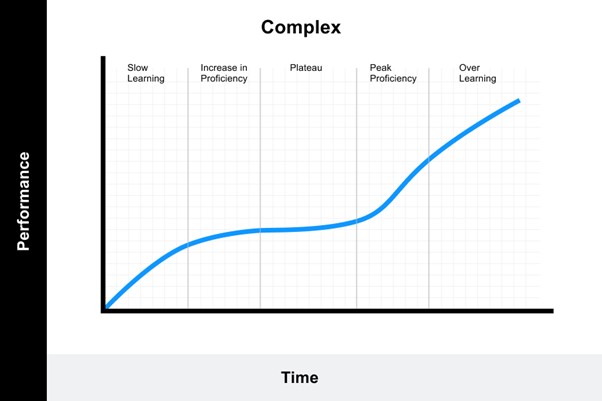
In hindsight my study time calculations didn’t account for the ebbs and flows of real life like sickness, family matters, and general professional workload. Study progression isn’t linear due to these outside factors, and I was probably in a plateau period around the time I want to sit my first attempt at the lab.
My work during this time was also misaligned to the tasks I would be carrying out in the lab so my attention had been divided for a lot of this time – I should have allowed longer for me to prepare.
Post-First attempt
I got my exam results while I was on holiday – which was fortunate in a lot of ways. I was decompressing already, and the break was really helping me get my focus back. Once I returned from my leave, I had a couple of weeks of catching up to do at work before I was off again to the Xperts APAC summit in Bangkok. At this conference I came across what is probably the best preparation for the FCX that I have seen:
The Ultimate Fabric Challenge
The Ultimate Fabric Challenge is an eSports skills competition, based on a series of Fortinet-centric cybersecurity challenges. To succeed, competitors must move through a 3d game world, discovering tasks that they must complete within virtual Fortinet environments. For the first two rounds, at the end of the allotted time the top 10 competitors with the most points continue through to the next round. This all culminates in a final round at Accelerate Vegas where the winner is crowned world champion. People within the Forti-sphere refer to this competition via its shorthand “UFC” – not having heard of this before, when the guys in my study group started talking about preparing for the UFC, I thought I had come across a group who were really into mixed martial arts.

I went into my first UFC round not having prepared at all and not knowing what to expect. The virtual environment handles remarkably like Minecraft, so I lucked out there having played a fair amount of Minecraft with my son. Being based around the security fabric, studying for the FCX is good training for the UFC. Having the time pressure and challenging tasks is great, but where this stands out is that you have access to the internet to help you solve problems.
Working through a FCX-like environment while being able to research the answers to the problems as you would in the real world is great practice for the FCX lab exam. It’s far more forgiving than the actual lab exam, allowing you to fall back on crutches like using google to figure something out.
You are also likely to come across some stiff competition at these events which pushes you to complete tasks in the most efficient way possible. For this first round it was largely based on technologies that I was familiar with, so I went fairly well with my partner and I coming in first in our pool.
The second round at the end of the conference however was with products that I had never touched before – this forced me to work through the environment continually using the documentation as a reference to complete tasks – I finished outside the top ten, but the experience I gained doing this under pressure was invaluable and I have no doubt it helped me when I came across tasks within the FCX Lab that I had never encountered (or even knew the products were capable of!).
If you get the chance to compete within the UFC in the lead up to your FCX exam I highly encourage you to do so as it can only assist in your preparations.
And so ends the first part of the last post of this series. In the next half, I run through my preparation for the second attempt at the FCX exam, including:
- My lab topology
- The Hardware and software I used to prepare for the exam
- What methodologies I used to prepare
- My Exam day experience
- Other tips and tricks, and some recognition for those who helped me along the way
I hope you have found this post informative and enjoyable, and thank you for reading this far
 FCX Study Group
Leave a comment