In the first of a new series from guest bloggers, we have Marco Bonaldo sharing his FCX experience with us. Marco passed his FCX in January 2025 to join the exclusive club of FCX – congratulations Marco!
If you would like to find out more about Marco or connect with him check out his LinkedIn Profile: https://www.linkedin.com/in/marco-bonaldo-76a63a155/

My name is Marco Bonaldo, I’m a Network & Security Engineer from Italy, and in January 2025, I passed the practical exam for the FCX certification. There is a lack of information about this certification compared to other top-level certifications from other vendors (CCIE, just to name one), and I believe that sharing my experience is a good way to help those who might be interested in tackling this important challenge.
This was one of the most challenging goals of my life—a two-year journey filled with immense sacrifices and countless hours of theoretical and practical preparation. The true value of this experience, certification apart, in my opinion was the significant growth of my technical and professional skills. I acquired new competences, strengthened existing ones, and, most importantly, continued to be driven by passion and curiosity.
One of the biggest challenges when preparing for high-level exams like the FCX is finding the right information on how to prepare effectively. Talking to those who have already gone through this experience is a great way to understand how to structure your study plan and which materials to use.
Personally, I had the chance to speak with two colleagues who obtained their certification years ago when the practical exam was held in France and lasted two days. Their insights were helpful at first, but since then, many things have changed. Eventually, I came across this blog, which turned out to be an invaluable resource, providing me with up-to-date information, helping me structure my study approach, and preparing me mentally to face the exam.
How I Prepared
I began studying for this certification in January 2023. At that time, I had active but expiring certifications for NSE4, NSE5 (FAZ and FMG), and NSE7 (EFW). My experience with the Fortinet ecosystem was already quite advanced, but it was particularly focused on FortiGate and SD-WAN, having worked on several complex projects involving this technology.
For this reason, I decided to start by renewing my NSE7 certification, studying and immediately passing the NSE7 – SD-WAN 7.0 exam. Then, I focused on the study guides and self-paced courses for the other FortiTechnologies.
To further expand my expertise, and in agreement with my company, I chose to take four exams from those eligible and necessary for the NSE6 certification. I completed them between April and September 2023, just before Fortinet phased out NSE6 in favor of the new certification program.
The exams I passed are as follows:
- Fortinet NSE 6 – FortiAuthenticator 6.4
- Fortinet NSE 6 – FortiWeb 6.4
- Fortinet NSE 6 – Cloud Security 7.0 for Azure
- Fortinet NSE 6 – FortiSwitch 7.2
In the following months, I continued studying the other topics covered in the Written exam, which I passed at the beginning of March 2024 on my second attempt.
Even in preparing for the Written exam, it’s essential to consolidate the concepts by practicing them in a lab environment. Personally, I waited until after passing the Written
to set up my own lab, but in hindsight, I would have done it much sooner. Fortunately, in the meantime, I was able to practice on an environment shared with other colleagues. And then again, who hasn’t had a “test client” at some point? Just kidding, of course… or maybe not. 😉
Below is a list of the various tools and resources I used to prepare for the certification:
EVE NG PRO
To tackle the Practical Exam, you need a lab!
And to build a lab, unless you own your own data center and have Elon Musk’s bank account, you need a virtualization environment. In my case, I used EVE-NG Pro VM, deployed in a Hypervisor that my company dedicates to labs and testing purposes. Additionally, you’ll need licenses for the entire study period.
Fortunately, with the right Fortinet contacts, it’s possible to get trial licenses. They are generally happy to help partners pursue this noble cause. I asked and, with no issues, I was granted 8 months of trial licenses for:
- 8 FortiGate VM02
- 2 FortiADC
- 1 FortiWeb
- 1 FortiManager
- 2 FortiAnalyzer
- 1 FortiAuthenticator
- 1 FortiClient EMS (25 users EPP)
- 1 FortiSandbox
- 2 FortiMail
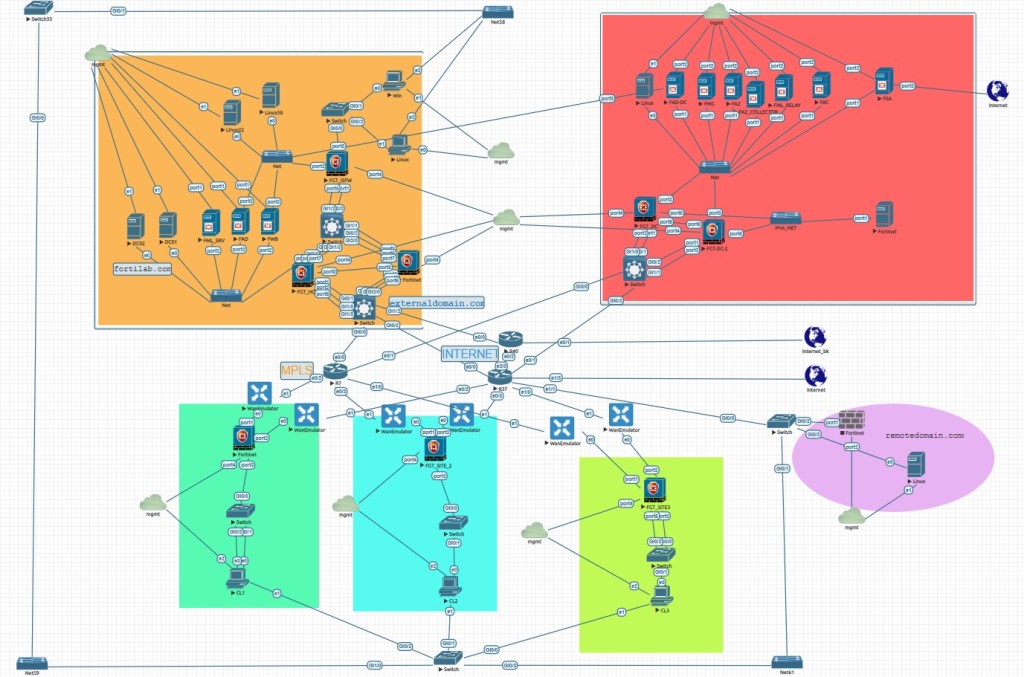
Within the lab, I added 5 clients (4 Windows and 1 Linux), two Domain Controllers, and some Linux Servers to run basic web pages or services such as FTP, DNS, and SMTP.
I simulated a dual-hub SD-WAN infrastructure composed by one HQ, one DC and three branches with dual connectivity (MPLS and Internet).
For network components, I used Cisco vIOS L2 and L3 images for switches and routers, as well as WAN emulators.
Finally, I connected a remote physical FortiGate via IPsec VPN, to which a FortiSwitch and a laptop were attached for testing.
Naturally, all of this stuff resulted in significant resource consumption, and more than once, I found myself spending a lot of time solving performance issues. Fortunately, I was able to rely on the help of colleagues who were much more experienced than me in the VMware world (Thank you guys!).
My advice? Carefully calculate the resources you’ll need and, if possible, overestimate. It’s better to have more resources from the start than to find yourself battling bottlenecks halfway through!
In my case:
- 20 vCPUs (quite undersized)
- 350 GB memory (undersized)
- 1 TB HD (more than sufficient)
Another piece of advice is to make regular backups of both the EVE-NG virtual machine and the device configurations.
Study Guide
Study guides and self-paced courses are essentially the same thing. They are essential for deepening the theoretical aspects, but they are often not enough to reach the level required for the FCX certification. It is definitely worth starting with these, especially if you do not already have an in-depth knowledge of the product. In my case, I had several gaps in FortiADC, FortiMail, FortiWeb, and FortiSandbox, so these materials helped me build a solid foundation.
Self-Paced Courses with LAB
A good way to familiarize yourself with the different technologies is to combine labs with the self-paced courses offered by Fortinet. The theoretical courses are free for partners, while the labs do come at a cost, which, although not excessive, should be taken into account. However, these courses are more focused on product knowledge rather than providing the in-depth level required for the exam.
FNDN
The FNDN portal is accessible to those who are already FCSS certified and offers advanced labs on different technologies. Personally, I repeated several times the ones related to SD-WAN, FortiAuthenticator, FortiLink, FortiNAC, and Security Fabric, finding them very helpful for consolidating my preparation on more technical and practical aspects.
Official Fortinet Courses
I attended the official Fortinet courses on FortiSandbox and FortiMail. Although the content is based on the study guides, the instructors are highly knowledgeable and can convey additional information that helps you better understand and assimilate the concepts. However, I recommend taking these courses only after you’ve already gained a decent knowledge of the product so that you can get the most benefit from them. The only real downside? The cost.
Bootcamp
The FCX Bootcamp is extremely useful for understanding the types of questions that may appear on the exam and their level of complexity. What it doesn’t prepare you for, however, is the mental and physical stress of managing the time during the actual exam…
Admin Guide
The Admin Guides were my main source of study for both the Written and Practical exams. However, it is essential to select topics and establish priorities, as, when adding up all the guides, I estimated a total of 15000-20000 pages.
To organize my study, the study tracker I found on this website was very helpful (Thank you again Andrew!). I took inspiration from that, I adapted it to my needs and expanded it by adding a sheet for each Admin Guide. On each sheet, I listed all the topics from the table of contents, with a direct link to the specific page.
For each topic, I assessed:
✔️ The probability (from 1 to 5) that it would be asked in the exam
✔️ My confidence level (from 1 to 5) on that topic
✔️ Whether I had already completed a lab on that functionality
This method allowed me to prioritize the most relevant topics and focus on those I felt less confident about. Of course, since this was a personal estimate, there was some margin for error: for instance, a topic I hadn’t studied at all did actually appear on the exam… but in most cases, the strategy worked well.
Lab Time
When I study a topic, I need to put it into practice: configuring the functionality, testing it, and understanding how it behaves in different scenarios.
Often, I let curiosity guide me:
What happens if I make this change?
What if I modify this other parameter?
What occurs in this specific scenario?
This approach takes a lot of time, but in my opinion, it is the most rewarding part of the preparation. This is where real progress happens because you’re not just memorizing, you’re truly understanding how the technologies work.
The Exam
I won’t dwell on the structure of the exam, as it’s already been thoroughly described by Andrew, but I’d like to share some practical tips.
The exam is nerve-wracking, almost a mystical experience. After nine hours, I didn’t even know who I was anymore, and it took me several hours to recover! 😵💫
The key is managing your energy and staying sharp. A drop in sugar levels can impact your concentration and, consequently, the entire session. You’re allowed to have food and drinks nearby: I had dried fruit, a banana, dark chocolate, water and coffee which were perfect for moments of need.
You get a one-hour break between sessions:
If you eat, keep it light! I opted for two eggs, avoiding heavy meals that could have made me sluggish.
Use the break to rest! It’s crucial to recharge for the second part of the exam.
Also, each session has two optional breaks. My advice? Use them strategically! Try to align them with the need to use the restroom and take a mental break for a few minutes. In the afternoon, for example, I didn’t take the second break because I was in a good rhythm: stopping might have slowed me down.
The day before the exam, make sure to get a good night’s sleep! Don’t make the same mistake I did… I only slept two hours, and I don’t recommend it to anyone! (Great advice, right? 😅)
Choosing the right location is crucial: first and foremost, make sure you have a good wired connection. Also, it needs to be a quiet and peaceful place where you’re sure you won’t be disturbed for the entire duration. These are not trivial considerations for everyone. In my case, for example, I would have preferred that Fortinet still gave the possibility of taking the exam at its facilities as a further alternative to the remote session.
One last tip: Use the notes section, especially if you get stuck on a task but feel you’ve approached it correctly. It seems, although not confirmed, that in some cases, partial answers may be evaluated positively if approached in the right way, giving you some extra points.
Conclusion
The feeling of being part of an elite group of expert cybersecurity engineers (less than 400 all over the world at the time of this writing) is something that I cannot put into words.
I wish everyone could experience the huge emotion of opening the official FCX communication email after several days of anxious waiting after the practical exam, anticipating that moment, and finally finding your unique number! I think my soul left my body in that moment, just to tell me: You did it!
In a second, you forget every sacrifice you made, every night spent struggling with the lab or reading tons of technical documentation after a full day of work, every time you said, “No, I’m sorry, I can’t, I have to study…” and so on.
Of course this is not for everyone, but (I’m the living proof) this milestone is not impossible. If you think you can do it, you must give yourself a chance.
Good luck to those who are thinking of starting or are already on their way on this great mountain climb. See you at the top!


 FCX Study Group
Leave a reply to Baqer Baqeri Cancel reply